
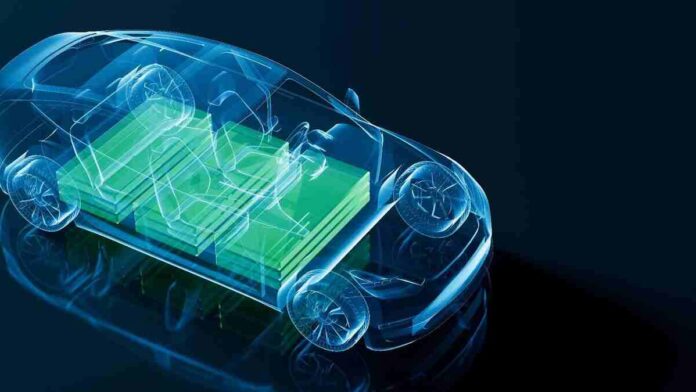
A major leap forward in electric vehicle technology has arrived as researchers reveal a new solid-state battery prototype capable of sustaining 2,000 full charge cycles without significant degradation. This advancement marks a turning point for the EV industry, which has long sought safer, longer-lasting, and more energy-dense alternatives to traditional lithium-ion batteries.
Solid-state batteries replace the liquid electrolyte found in conventional batteries with a solid conductive material. This single change unlocks multiple advantages—higher energy density, improved safety, lower overheating risk, and faster charging. However, the challenge has always been durability. Many solid-state designs degrade quickly under repeated charging, preventing large-scale commercial adoption. The new prototype overcomes this barrier with a stable electrolyte composition and reinforced electrode architecture, showing far slower wear over time.
The breakthrough’s highlight is 2,000 charge cycles, equivalent to driving an EV for nearly a decade without needing a battery replacement, assuming average annual mileage. Current lithium-ion packs typically last 1,000 cycles before noticeable capacity loss. This doubling of lifespan positions solid-state technology as a game-changer for both consumers and manufacturers.
Automakers stand to benefit significantly. Longer-lasting batteries reduce warranty risks and allow companies to offer extended battery guarantees, improving customer confidence. Additionally, the higher energy density means vehicles can achieve longer driving ranges without increasing battery size. A compact yet powerful battery allows for slimmer vehicle designs, lighter frames, and improved overall efficiency.
One of the most promising aspects is enhanced safety. Solid electrolytes eliminate the flammable liquids used in lithium-ion batteries, reducing fire risks associated with thermal runaway. This stability enables EV makers to pack cells more tightly together, maximizing space while maintaining safe temperatures. As a result, upcoming EV models could deliver stronger performance in a more compact footprint.
Charging speed also receives a boost. The improved electrolyte interface allows rapid ion movement, enabling fast-charging sessions with lower heat generation. Drivers could see charging times shrink significantly, bringing EV convenience closer to traditional refueling experiences.
Beyond automobiles, this innovation paves the way for widespread applications in grid storage, aerospace, robotics, and consumer electronics. Longer-lasting, safer batteries can stabilize renewable energy grids, power drones for extended periods, and improve safety in high-performance electronic devices.
While the prototype demonstrates remarkable potential, scaling manufacturing remains the next major challenge. Solid-state batteries require highly precise production techniques, and materials used for solid electrolytes can be costly. However, as demand accelerates and investment grows, production efficiencies are expected to improve. Companies worldwide are racing to adapt this technology for mass-market use, aiming to introduce solid-state-powered EVs within the next few years.
Industries are optimistic because this new prototype represents not just incremental progress but a significant technological milestone. Achieving durability without sacrificing energy density or safety has long been considered the “holy grail” of EV battery research. With this advancement, the vision of long-range, ultra-safe electric vehicles is no longer theoretical—it is rapidly entering commercial reality.
As global pressure increases to adopt cleaner transportation, innovations like the 2,000-cycle solid-state battery are shaping the next chapter of mobility. Consumers can look forward to EVs that charge faster, travel further, last longer, and deliver safer performance across their entire lifespan.

